Saint Mary’s University AI HVAC Optimization Case Study
ECOPILOT PROJECT SPOTLIGHT | HIGHER EDUCATION
Smarter Buildings. Smarter Campus. Real Results.
How Saint Mary’s University is using AI-powered HVAC optimization to autonomously reduce energy consumption, improve operational intelligence and unlock new efficiencies across its Halifax campus.
At Saint Mary’s University (SMU), a diverse portfolio of campus buildings presents a familiar challenge for institutional facility managers: how do you improve energy efficiency across buildings of different ages, infrastructure and operating requirements without undertaking costly mechanical system replacements?
Through its collaboration with EcoPilot, SMU is demonstrating how artificial intelligence can work alongside existing building automation systems to transform traditional, reactive HVAC operations into predictive, continuously optimized performance.
The Challenge: One Campus, Generations of Infrastructure
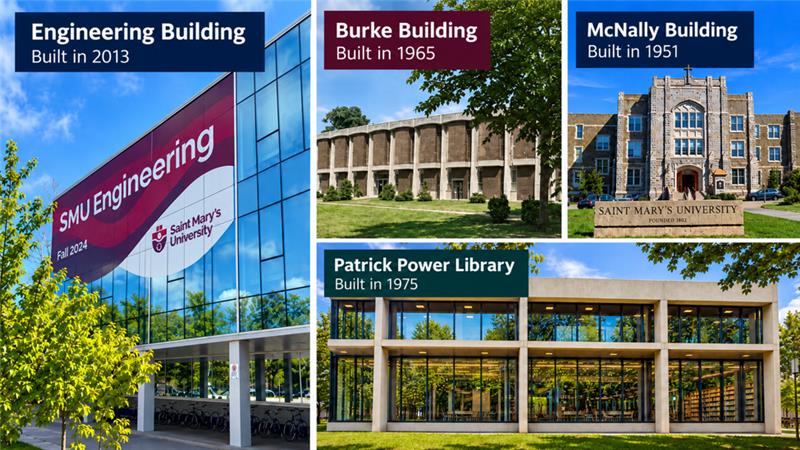
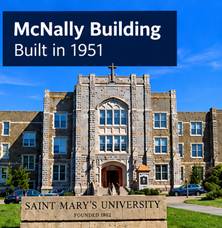
Like many established university campuses, Saint Mary’s operates a mix of historic and modern facilities with distinct thermal characteristics, occupancy patterns and HVAC infrastructure.
While conventional building automation systems (BAS) effectively manage equipment and maintain operating conditions, their control strategies often rely on predetermined schedules, fixed parameters and responses to current conditions.
These approaches do not always account for a building’s ability to store and release heat, changing occupancy patterns or forecast weather conditions.
For SMU, the opportunity was to introduce an additional layer of intelligence that could optimize energy consumption across campus while respecting the individual operating requirements of each building.
The Solution: From Reactive to Predictive HVAC Control
SMU implemented EcoPilot’s iBOS energy® AI optimization platform, integrating directly with SMU’s existing building automation infrastructure. Rather than replacing existing controls, EcoPilot adds predictive intelligence, continuously calculating optimal heating and cooling requirements based on real-world operating conditions.
- Weather intelligence Uses current conditions and weather forecasts to anticipate changing heating and cooling demand.
- Building thermal behaviour Accounts for how individual buildings retain and release heat, supporting more efficient control strategies.
- Schedules and occupancy Aligns HVAC operation with building usage and changing campus activity.
- Continuous optimization recalculates optimal control setpoints approximately every two minutes, adapting to changing conditions while maintaining occupant comfort.
The campus-wide implementation includes software integration, wireless temperature sensors, building automation connectivity and commissioning of heating and cooling systems.
Seeing the Difference: Real Operating Data
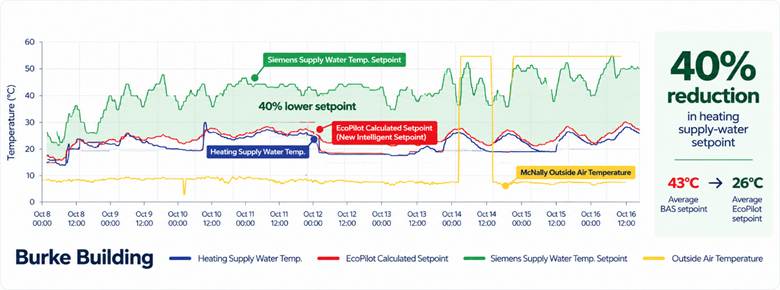
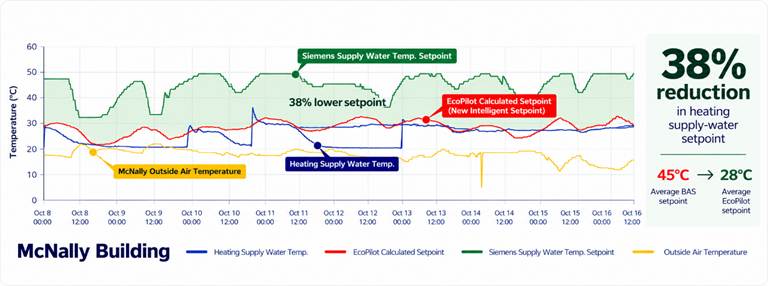
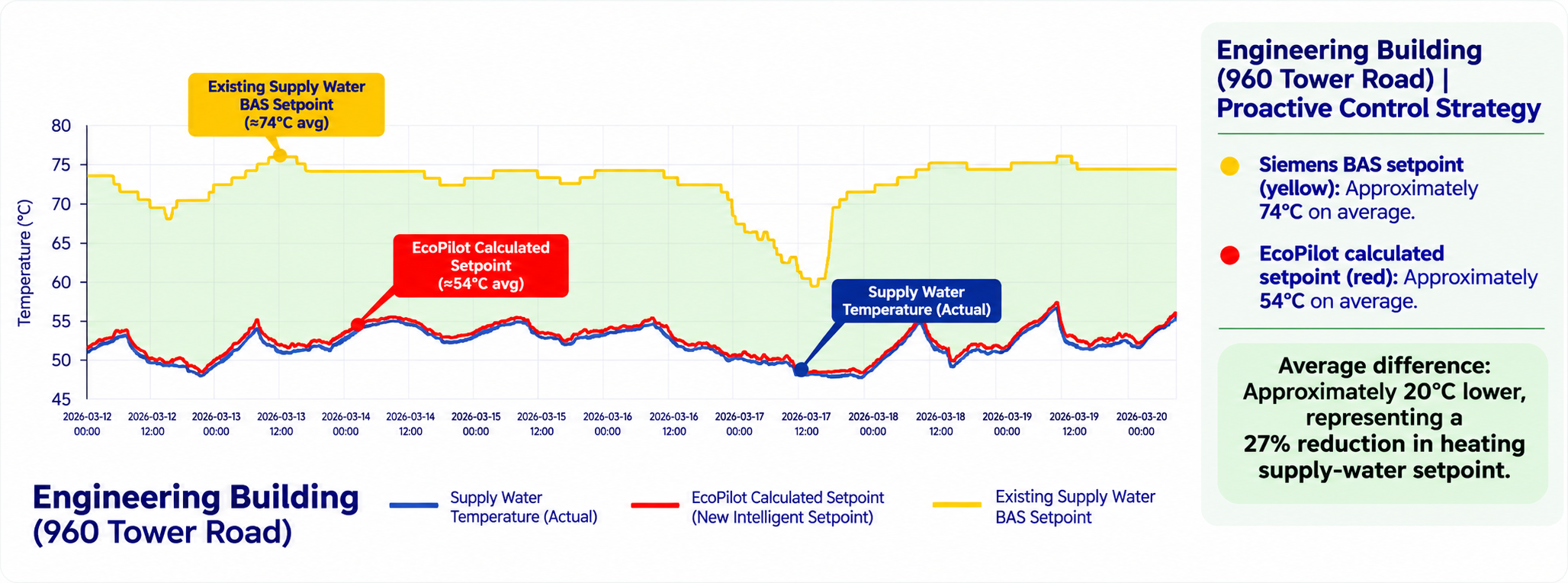
One of the most compelling findings from the SMU project is the difference between traditional BAS temperature setpoints and those calculated through EcoPilot’s predictive optimization.
The early operating data demonstrates opportunities to deliver heating at substantially lower supply-water temperature setpoints than conventional control strategies would otherwise specify.
Burke Building
 |
 |
McNally Building
 |
 |
Engineering Building
 |
 |
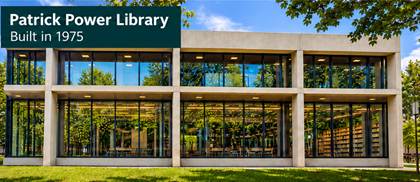
Patrick Power Library
|
|
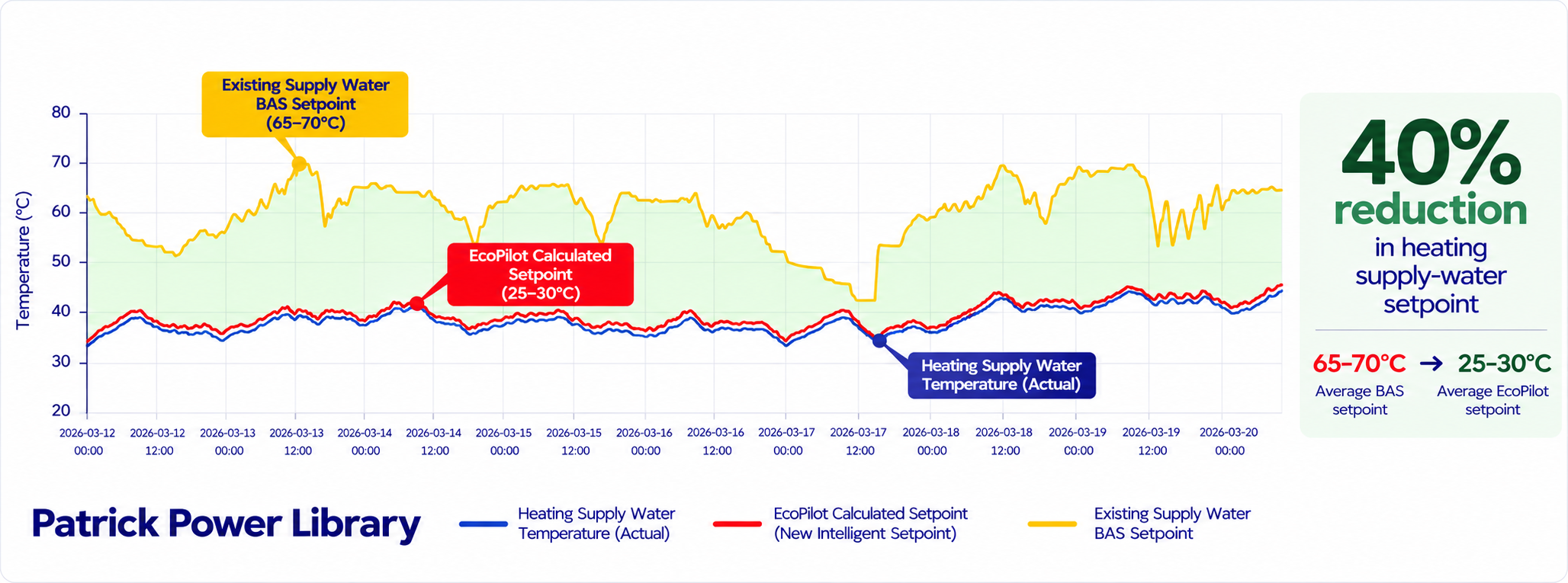 |
These results demonstrate how building-specific predictive control can identify opportunities to reduce unnecessary heating demand while supporting required indoor conditions.
Importantly, a reduction in supply-water temperature setpoint is not equivalent to the same percentage of energy savings. Actual energy savings are measured separately through utility consumption and weather-adjusted analysis.
Early Results: Measurable Energy and Cost Savings
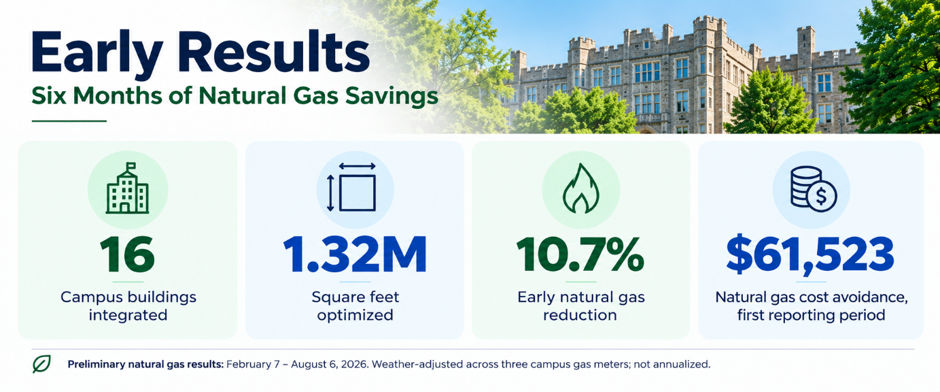
Early results from SMU demonstrate the financial and operational potential of predictive HVAC optimization across a complex institutional portfolio.
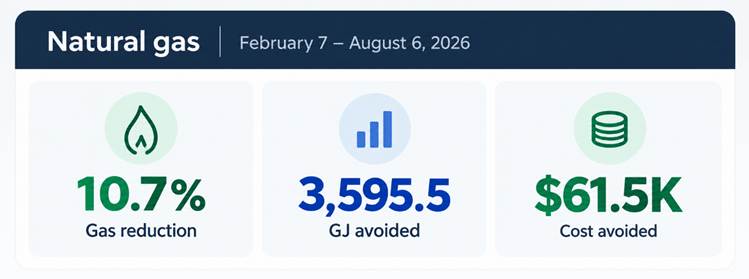
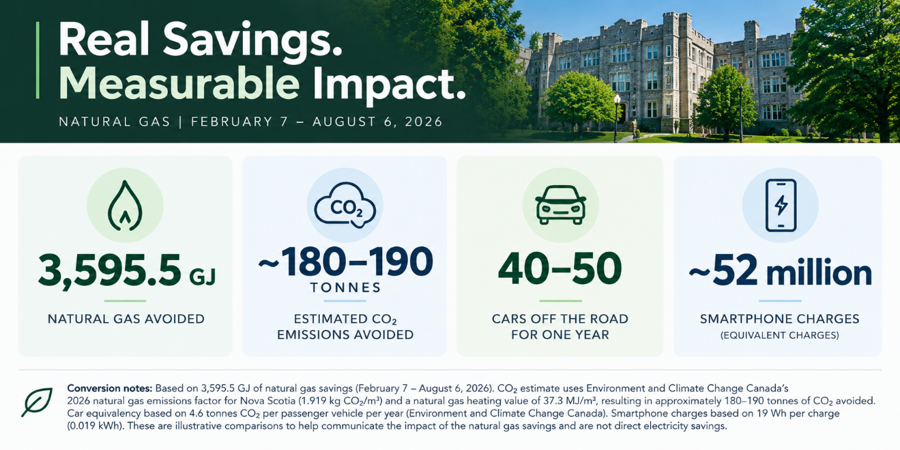
Weather-adjusted results across three campus gas meters. Approximately 998.7 MWh equivalent energy avoided. Results are preliminary and reflect the stated reporting period.
Early electricity analysis at the Patrick Power Library also identified 6.7% savings, representing approximately 23 MWh of avoided consumption, measured against an approved baseline.
Campus-wide electricity savings analysis remains ongoing, including additional evaluation of chilled-water optimization and chiller performance.
Turning Energy Savings into Environmental Impact
Saint Mary’s University achieved meaningful natural gas savings through EcoPilot’s AI-powered HVAC optimization. The graphic below translates these early results into everyday equivalents, illustrating how smarter building operations can reduce carbon emissions and support a more sustainable campus.
How Savings Are Measured
EcoPilot uses RETScreen-supported, weather-adjusted measurement and verification to evaluate actual energy performance against expected baseline consumption. Historical utility and weather data establish a baseline model, which is normalized for actual weather conditions and compared with metered consumption to calculate avoided energy use.
This methodology provides a transparent foundation for ongoing performance review and helps distinguish measurable energy savings from operational improvements.
Beyond Energy Savings: Smarter Building Intelligence
At Saint Mary’s University, EcoPilot is demonstrating that AI-powered HVAC optimization delivers more than energy savings. Continuous monitoring also provides valuable operational insights, helping facilities teams identify inefficiencies, troubleshoot issues and prioritize improvements. At Loyola Residence, for example, EcoPilot identified an upper-floor comfort issue influencing heating demand throughout the building. While optimizing the East and West heating loops, the system also highlighted an opportunity to address underlying heat loss and potentially unlock additional savings. This is where predictive AI adds value: not simply controlling HVAC equipment, but turning building performance data into actionable intelligence.
Through ongoing monitoring and collaboration with SMU’s facilities team, EcoPilot has identified several opportunities for further optimization:
• Loyola Residence: Investigate upper-floor heat loss to improve comfort and reduce heating demand.
• Burke Building: Refine heating setpoint ranges in preparation for colder weather.
• Patrick Power Library: Optimize chilled-water control ranges to improve cooling efficiency.
• Campus-Wide Operations: Resolve BAS communication issues and support continuous performance reviews.
AI optimization is not a one-time installation. It is an ongoing operational strategy that helps buildings become smarter, more efficient and better understood over time.
A Collaborative Approach to Campus Optimization
The implementation at Saint Mary’s University required close collaboration between EcoPilot’s technical team and SMU’s facilities personnel.
Integrating across multiple buildings and control environments involved system commissioning, building-specific adjustments, troubleshooting and continued performance monitoring.
This collaborative approach helps ensure predictive optimization works alongside existing building systems and operating practices, rather than creating an additional burden for facilities staff.
As operational data accumulates, EcoPilot and SMU can continue to refine control strategies, identify opportunities and evaluate performance, as well as opportunities, across the campus.
Looking Ahead: The Future of Intelligent Campuses
The opportunity extends beyond immediate HVAC energy savings. With greater visibility into building behaviour and actual energy demand, AI-enabled optimization can help institutions plan for a more efficient and resilient future.
Potential applications include campus-wide energy coordination, predictive maintenance insights, peak-demand management, support for decarbonization strategies and more informed equipment replacement and capital planning.
For Saint Mary’s University, the project provides a foundation for continuous improvement while demonstrating how existing infrastructure can be part of a smarter, more sustainable campus.
To learn more about sustainability initiatives, programs and research at SMU, visit Sustainability at Saint Mary's.
See EcoPilot in Action at Saint Mary’s University
Take a virtual tour of SMU’s HVAC optimization project and watch our webinar, AI for HVAC in Education, to explore the technology, insights and early results.
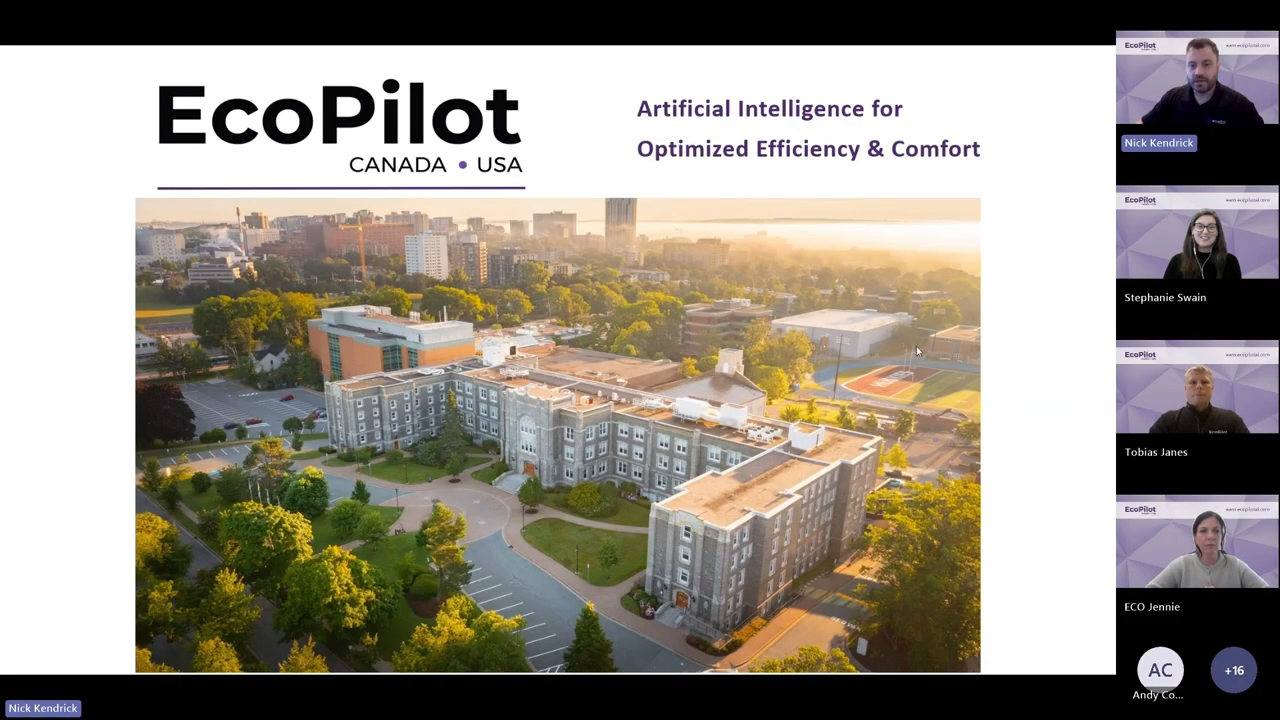
Watch the replay of our Education Facilities AI for HVAC webinar featuring a live building demo at Saint Mary’s University and an open Q&A led by Tobias Janes, Director of Technical Solutions.
In this session, discover how AI for HVAC is being applied across education facilities to improve building performance, reduce energy waste, and support consistent indoor conditions for learning.
Watch the full replay, then explore more:
Website: www.ecopilotai.com
Book a free assessment: www.ecopilotai.com/contact
Ready to explore AI for HVAC in education?
Connect with EcoPilot to learn how AI-driven HVAC optimization can help education facilities improve building performance, reduce energy waste, and support better learning environments.
Your Buildings May Be Smarter Than You Think. Universities and institutional property owners do not necessarily need new HVAC equipment to achieve meaningful energy savings. Sometimes, the greatest opportunity lies in operating existing infrastructure more intelligently. EcoPilot helps institutions identify those opportunities through complimentary building assessments, flexible implementation options and ongoing performance monitoring. Discover what predictive AI optimization could deliver for your campus.
Prefer to talk with us directly?
Book a free assessment or contact the EcoPilot team to discuss your building or campus portfolio.
Email: info@ecopilotai.com